Editor’s note: This article originally appeared in The Scribe, Georgia’s Drug Recognition Expert Newsletter, Volume 1, Issue 1 (Summer 2012). It is reprinted here with the author’s byline and references intact.
Introduction
One of the most important observations that an officer investigating an impaired driver can make occurs during the third component of the Horizontal Gaze Nystagmus (HGN) test, when checking for the Onset of Nystagmus Prior to 45 Degrees in each eye. This article briefly reviews what is known about this phenomenon, what the results imply, and how they can be useful to law enforcement.
What We Know From Research Studies
Medical and scientific literature published over the past 50 years and more shows that certain drugs, specifically, barbiturates, and alcohol can cause particular types of nystagmus (Bender and O’Brien, 1946; Aschan, 1958). Later reports indicate that other Central Nervous System Depressant drugs, Inhalants, and Dissociative Anesthetics also can cause some of these types of nystagmus (see review in Talpins and Hayes, 2004). This is the foundation of what eventually developed into the HGN test.
In the 1970s and 1980s, reports were published demonstrating that, when alcohol is the only intoxicant, the Angle of Onset of Nystagmus (AON) decreases in a predictable manner as intoxication level increases (Lehti, 1976; Tharp et al., 1981; Goding and Dobie, 1986). Overall, these studies show that there is a correlation of about 75% between AON and Blood Alcohol Concentration (BAC). (Technically, the correlation is negative, since AON decreases as BAC increases; this is a mathematical detail with which we do not need to be concerned in order to understand the concept.) Even though we expect to observe a decrease in AON with increasing levels of non-alcohol drug concentrations, such a straightforward relationship does not exist for drugs other than alcohol, because several additional factors often must be considered, including the user’s individual physiology and previous experience with or tolerance to the drug. Nonetheless, when these drugs are taken at dosages or in combinations that could cause impairment, the expected changes in eye movements assessed with the HGN and VGN tests will be observed.
What the Results Imply: The Mathematical Relationship Between AON and BAC
For intoxication caused by alcohol alone, the 75% correlation means that either:
for any given BAC, a group of individuals will exhibit a range of AON; or
for any given AON, a group of individuals will exhibit a range of BAC.
Thus, for any one person, a particular BAC will not predict an exact AON, rather a value within a possible range of AON, usually within about plus or minus 3 degrees. Conversely, for any one person, a particular AON will not predict an exact BAC, rather a value within a possible range of BAC, usually within about plus or minus 0.03 g/dl.
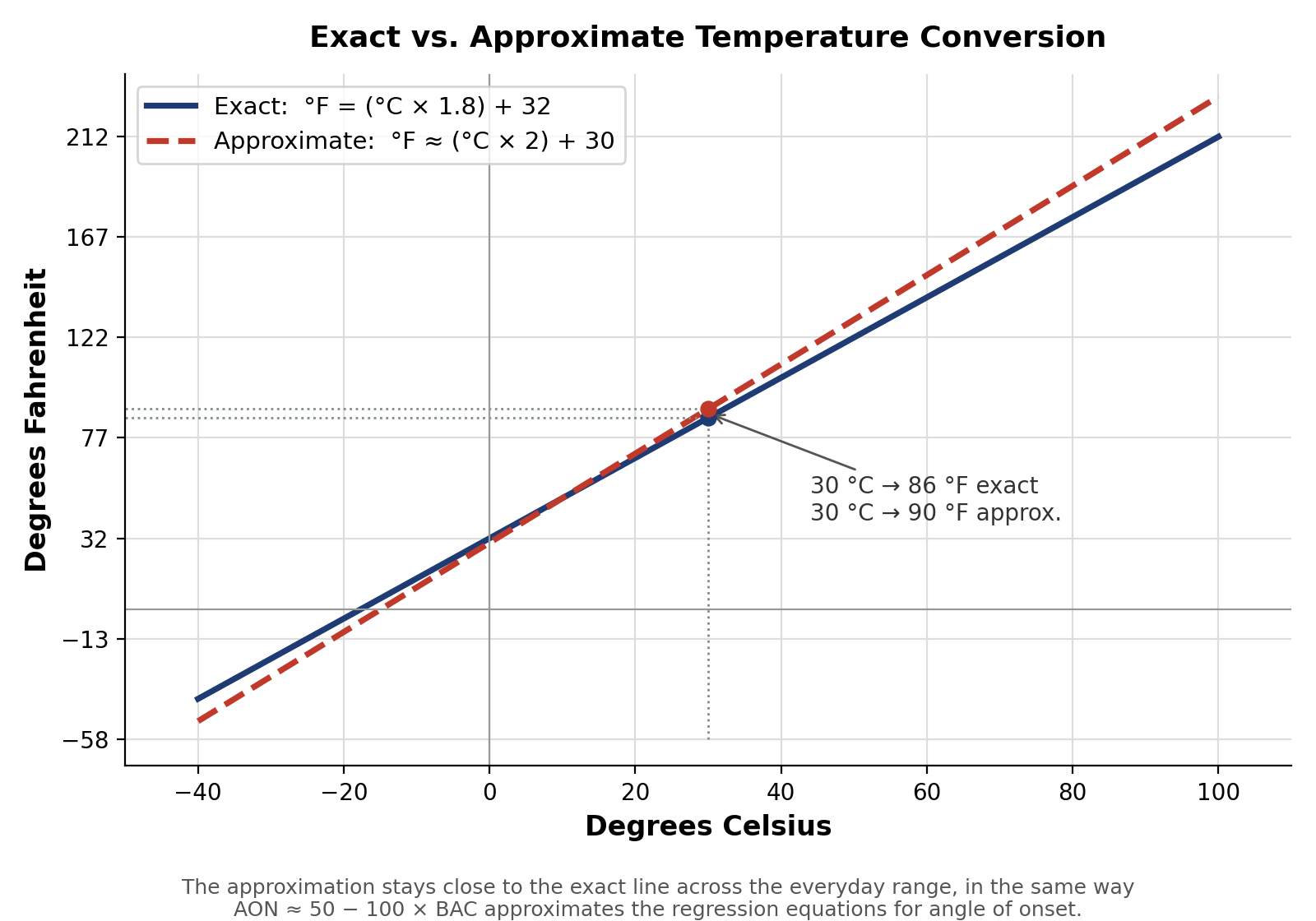
More on this later. Let us first consider what happens when two factors have a mathematical relationship with 100% correlation: there is perfect predictability of one factor with respect to the other, and each value of one factor corresponds to a single, unique value of the other. For example, temperature (temp) in degrees Fahrenheit (degF) versus degrees Celsius (degC) has a 100% correlation. There is an exact linear (that is, straight-line) equation that explains this relationship, which can be written in either of two ways, depending on which temperature you are given:
Given temperature in degF, find the temperature in degC using:
temp in degC = (temp in degF − 32) / 1.8 (Equation 1)
or, given temperature in degC, rearrange Equation 1 to find the temperature in degF using:
temp in degF = (temp in degC × 1.8) + 32 (Equation 2)
For a quick approximation that you can likely do in your head, or simply with pencil and paper, even without using a calculator, replace 1.8 with 2 and replace 32 with 30:
Given temperature in degF, find the approximate temperature in degC using:
temp in degC ≈ (temp in degF − 30) / 2 (Equation 1a)
or, given temperature in degC, rearrange Equation 1a to find the approximate temperature in degF using:
temp in degF ≈ (temp in degC × 2) + 30 (Equation 2a)
For example, if a tourist from Canada visits the US when the expected temperature is 30 degF, he will know to wear a warm coat, since that is (30 − 32) / 1.8 = −1.1 degC (exactly, using Equation 1) or (30 − 30) / 2 = 0 degC (approximately, using Equation 1a). On the other hand, a US citizen visiting Canada when the expected temperature is 30 degC will know to wear shorts, since (30 × 1.8) + 32 = 86 degF (exactly, using Equation 2) or (30 × 2) + 30 = 90 degF (approximately, using Equation 2a). Note that in both cases the approximate formulas give answers that vary from the exact results, but they are close enough to provide a general indication as to what the temperature will be.
Tharp et al. (1981) reported several correlation equations for AON versus BAC. When all of the data are considered together, an overall regression equation emerges:
AON = 51 − 105 × BAC (Equation 3)
When the data from Lehti (1976) are analyzed in the same manner and with the same units as those used by Tharp et al., the following regression equation results:
AON = 55 − 125 × BAC (Equation 4)
As in the example for temperature, both Equations 3 and 4 can be approximated as:
AON ≈ 50 − 100 × BAC (Equation 5)
Equations 3, 4, and 5 thus allow you to calculate AON given BAC. (The equal sign is used in Equations 3 and 4, because these represent the actual linear regressions.) But all of these truly are primarily estimates when considering individual values, since the correlation is not 100%; as stated above, the true relationship between AON and BAC can vary from one person to the next. (One way to think about these linear regression equations is that, for any BAC, the equation gives the average of all the AONs exhibited by subjects with that BAC.)
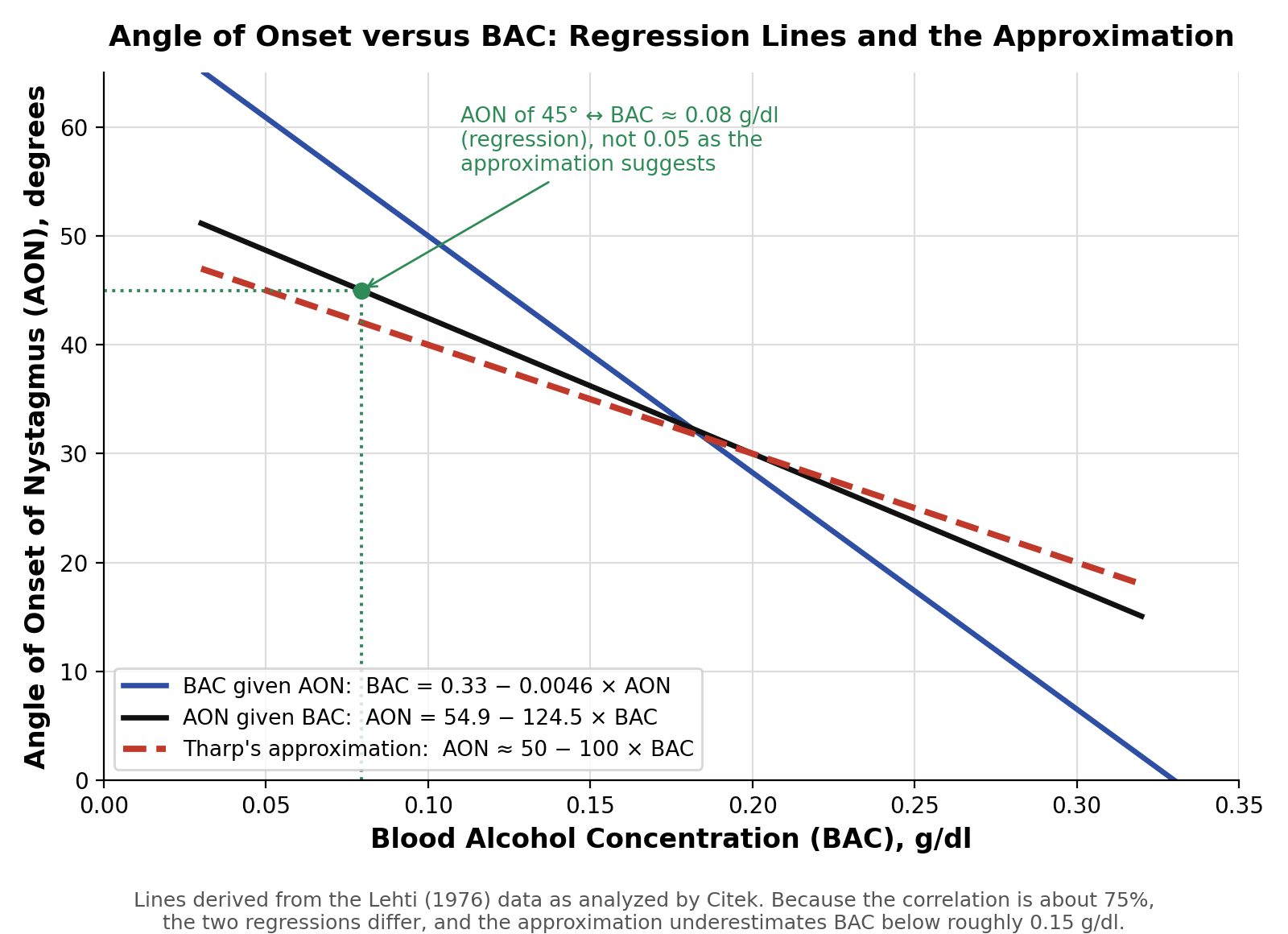
For law enforcement purposes, though, we would like to estimate BAC given AON, since AON is the observation that the officer makes. Because the correlation is not 100%, these regression equations are not simply the inverses of Equations 3 and 4, that is, not BAC = (51 − AON) / 105 and BAC = (55 − AON) / 125, respectively. Nonetheless, the inverse of Equation 5, which can be solved easily by most people without using a calculator, does produce an adequate approximation for the intended purpose and is consistent with most officers’ observations:
BAC ≈ (50 − AON) / 100 (Equation 5a)
Over the years, Equation 5a has colloquially been referred to as “Tharp’s equation,” in honor of the first author of the second NHTSA validation study report (Tharp et al., 1981). I recommend that, if you intend to use the name, then refer to it as “Tharp’s approximate equation,” to emphasize the fact that it does not characterize an exact or precise relationship between the factors nor for any given individual. In fact, when the exact regression equations (not shown here) are used to calculate BAC given AON, an AON of 45 degrees results in a BAC of 0.08 to 0.10 g/dl for most individuals, rather than 0.05 g/dl, as Equation 5a would suggest. As a consequence, for BACs below about 0.15 g/dl, Tharp’s approximate equation underestimates BAC for most subjects! Conversely, for BACs above about 0.20 g/dl, Tharp’s approximate equation would overestimate BAC; but this is not a significant issue, because an AON of 30 degrees or less almost always will be identified as “immediate onset” by the officer, thus representing a high level of intoxication.
What the Results Mean to the Officer and the Prosecutor
Officers typically are taught to assess AON as “immediate” (that is, not present when looking straight but as soon as the stimulus is moved away from straight ahead), 30 deg, and then increasing in 5-degree increments. With practice, some officers can learn to estimate AON to within plus or minus 1 deg, although this is not a requirement. Applying Tharp’s approximate equation, the officer expects to measure a BAC to within plus or minus 0.03 g/dl of the result of the equation, if alcohol is the only intoxicant present. If the angle estimate is accurate, rarely will the actual BAC be higher than the upper limit of the expected BAC. However, if drugs other than or in addition to alcohol are present, such as Central Nervous System Depressants, Inhalants, or Dissociative Anesthetics, then actual BAC will be much lower than expected; this is one of the classic reasons for requesting and conducting a Drug Evaluation!
At a hearing or trial, Tharp’s approximate equation, if it is discussed at all, often will be characterized as exact and absolute, with erroneous arguments such as, “If AON is exactly 45 degrees, then BAC cannot be greater than 0.05 g/dl.” On rebuttal, remind the court that, even though the equation is a very useful and relatively simple tool for an officer conducting a roadside DUI investigation, it provides only an approximation, and typically an underestimate at that, of the suspect’s BAC. As with all other clues on all field sobriety tests, both standardized and non-standardized, this clue contributes to an officer’s probable cause for arrest. While its presence is consistent with impairment caused by intoxication, it does not, and never was intended to, prove or disprove an exact intoxication level for the individual subject.
Conclusion
The relationship between AON and BAC has long been known, and it can be described using a mathematical equation that is relatively simple, albeit somewhat esoteric in origin and explanation. Nonetheless, armed with this understanding, both the law enforcement officer and the prosecutor can apply the principles of this relationship to maximum benefit and learn to counter any incorrect or inappropriate arguments against its use.
References
Aschan G. Different Types of Alcohol Nystagmus. Acta Oto-Laryngologica Supplement 1958; vol. 140, pp. 69-78.
Bender MB, O’Brien FH. The Influence of Barbiturate on Various Forms of Nystagmus. American Journal of Ophthalmology 1946, vol. 29, pp. 1541-1552.
Goding GS, Dobie RA. Gaze Nystagmus and Blood Alcohol. Laryngoscope 1986; vol. 96, pp. 713-717.
Lehti H. The Effect of Blood Alcohol Concentration on the Onset of Gaze Nystagmus. Blutalkohol 1976, vol. 13, pp. 411-414.
Talpins SK, Hayes CH. The Drug Evaluation and Classification (DEC) Program: Targeting Hardcore Impaired Drivers. American Prosecutors Research Institute 2004.
Tharp V, Burns M, Moskowitz H. Development and Field Test of Psychophysical Tests for DWI Arrest. National Highway Traffic Safety Administration, U.S. Department of Transportation 1981, No. DOT-HS-805-864.