By Aaron Botts
*“Officer, you stated on Direct that you suspected my client was impaired before you even spoke with him, correct?” “Yes,” I said. “Is it possible for someone distracted by a passenger to weave across the lane line?” the defense lawyer asked. “Yes,” I said again. “And isn’t it possible for someone who isn’t familiar with the area to drive under the speed limit?” he asked. “It is,” I responded. “So then you would agree that you cannot know if someone is drunk until you actually speak with them, correct?” “No, sir. Based on the driving I observed, there was at least a 65% chance the driver was impaired.”
This is an exact quote from a cross-examination I had just one week before writing this article. Session 5 of the DWI Detection and SFST Manual is almost entirely predicated on a study titled “The Visual Detection of DWI Motorists.” You can probably recall the rolling piano theme that opens the video where we first learn about this study in class. Then we watch vehicles weaving, taking wide turns, and a lady throwing a beer can at road sign. Today, all of that seems like common sense when we think of a drunk driver. But this study is crucial because it backs up our common sense with valid and reliable science.
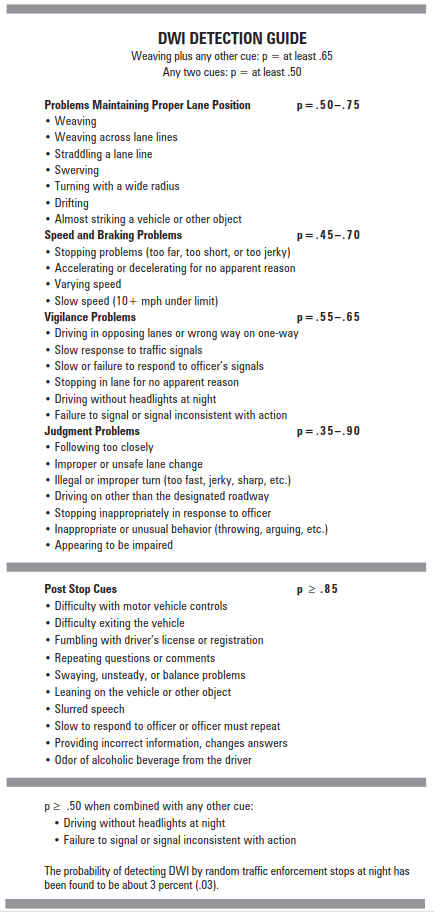
As a reminder, the study began in 1979 and analyzed more than 12,000 enforcement stops across three field studies. Over 100 cues of impaired driving were considered, then narrowed to 24 cues divided into four categories: Problems in maintaining proper lane position, Speed and braking problems, Vigilance problems, and Judgment problems. Any one of these 24 cues, on its own, predicts a DWI driver at least 35% of the time. But the real power of this study appears when you look at the combinations of violations. And remember, this study was done when the per se limit was 0.10% BAC, not 0.08% BAC.
Digging into these combinations is where the science helps an officer not only defend decisions in court but also find impaired drivers more efficiently. While observing any single cue yields at least a 35% chance of impairment, any two cues raise that to at least a 50% chance. So, for the officer working an impaired driving grant, waiting for two violations improves efficiency. This also applies to specific violations, for example, Driving Without Headlights at night combined with any other cue yields at least a 50% chance of impairment. The same goes for failing to signal or signaling inconsistently with the driving action, combined with any other cue.
And finally, Weaving plus any other cue in the DWI Detection Guide yields at least a 65% chance of impairment. That’s exactly what my response in the cross-examination was based on. Why can we talk about this in court? Because it appears at the end of Session 5: Vehicle in Motion. If the DWI Detection and SFST Manual has been discovered, then everything we’ve discussed is already on the record.
Is there more? Of course there is. This is DrugImpairment.com—we don’t stop with the basics. The guide is based on a bona fide scientific study. For the truly dedicated impaired-driving hounds out there, listing the study itself on your CV or getting it included in discovery gives you even more to talk about. In the case above, I observed: driving more than 10 mph under the speed limit, weaving, and weaving across lane lines.
If we take the three observed driving actions and apply them to the data in the Phase 2 report of the study, we find that when weaving is observed as part of three or more cues, there is a 76% chance the driver is impaired. Again, remember this was based on a 0.10% BAC standard. The study also analyzed results at the 0.050% BAC level. So, for those of us in states with a “less safe” law, the study shows an 85% chance the driver is impaired above 0.050% BAC.
I tell you all of this to remind you: there is always more information. The DWI Detection and SFST Course is the baseline for an officer beginning the journey. For the SFST Instructor, diving into the pamphlet at the end of Session 5 helps you teach and helps you articulate your observations of driving behavior. For those seeking true expertise, reading the study behind the presented data gives you insights that make you bulletproof in court and deadly accurate when searching for impaired drivers.
*Defense counsel just stared and blinked slowly for several seconds before responding, “Sixty‑five percent… how do you figure?” I began, “Well, that’s the lowest chance. It was also up to an 85 percent chance based on the study presented in Session 5 of the DWI Detection and SFST Manual, ‘The Visual Detection of DWI Motorists’…” *
And you can fill in the rest.